1 March 2025
Building a Career in Broadcast Through Steadicam
Freelance television cameraman and Steadicam owner-operator Alex Doherty shares his career path, the essential skills behind live broadcast Steadicam work, and practical advice for excelling in broadcast and live television production.
Read the full feature
When I first entered the television industry, I had no idea I was also building my own brand. The concept of ‘self-branding’ wasn’t something I was familiar with—I was simply focused on expanding my knowledge of broadcasting and being true to myself. Over the years, I’ve built my career as a camera operator, gaining experience across a wide variety of projects and genres, from sports and live events to music and studio productions. I’ve leaned into specialising in Steadicam, making it a defining focus of my work and a new chapter in my career.
So, when the GTC invited me to share my journey and insights from over two decades in the business and my thoughts for the future, I eagerly embraced the opportunity.
After sending what felt like hundreds of letters to various media companies, I was offered an apprenticeship at ITV Central at 17. There, I shadowed the technical support department and learned the inner workings of a television station. Engineers showed me the essentials of play-out and distribution, including MCR (Master Control Room)—responsible for managing all incoming and outgoing signals. This experience gave me a foundational understanding of broadcast and news operations that has been invaluable throughout my career.
Building skills and navigating diverse productions
Working across a wide range of productions, it’s easy to get typecast in a specific genre, especially in sports. However, my experience spans various events and genres, from Premier League football to the UEFA Euros and the Tokyo Olympics. Since I wasn’t a football fan and didn’t follow any team, I thought that might be a disadvantage. However, it turned out to be a benefit, as it allowed me to cover the game impartially without being emotionally invested in any team’s outcome. That said, when a match heads into extra time or penalties, you sometimes find yourself quietly hoping for one side to win before the 90 minutes are up.
In sports, I’ve covered everything from high-profile tournaments like All Elite Wrestling and ATP Tennis in Madrid to unique events like the Moto Cam coverage on the London Half Marathon. Each event presents a new challenge and requires a distinct approach; for example, football coverage demands real-time tracking of fast action, while events like boxing and snooker focus more on capturing intense, close-up details. Whether it’s a Premier League match, NFL London series, or the Commonwealth Games boxing, each sport has its own rhythms and requirements, and working in these diverse settings has strengthened my ability to quickly adjust to each production’s unique demands.
The best seat in the house
I’ve been fortunate to work on games ranging from the conference league up to prestigious World Cup matches, covering every league and tournament in between. This range of experience has given me a unique perspective on the game at every level, from local league atmospheres to the high-stakes energy of international tournaments.
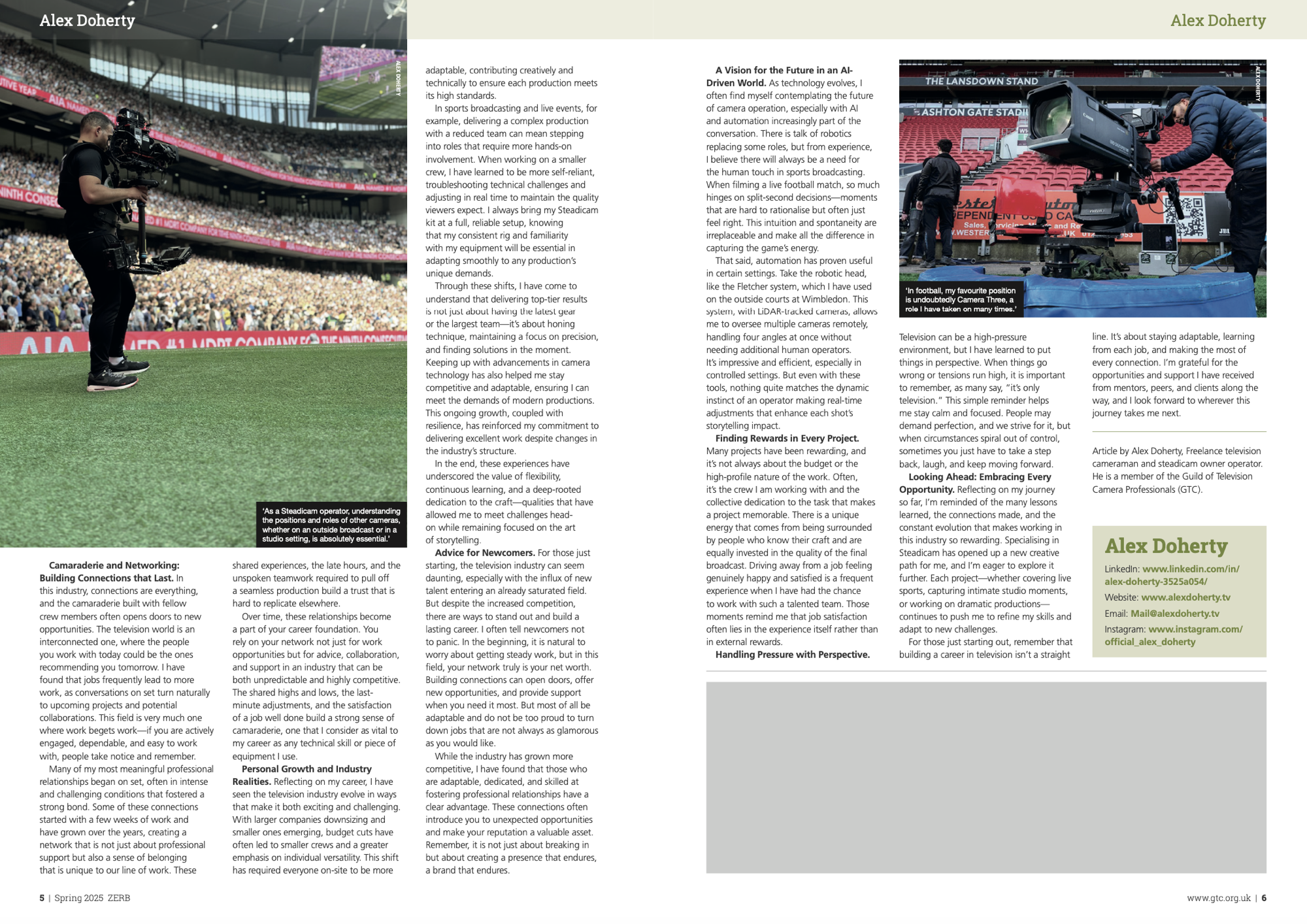
In football, my favourite position is undoubtedly Camera Three, a role I’ve taken on many times. Positioned on the same side of the pitch as the other main cameras, Camera Three sits on the halfway line—typically with an 86:1 lens or larger—either between the dugouts or beside them. Its placement provides a low, close-up perspective that captures the game’s intensity. If you imagine a football match as a two-sided story, Camera Three usually covers the “good guy,” while Camera Two focuses on the “bad guy”—adding to the narrative through visual perspective. With gripping commentary and a good director, the coverage will tell a story.
Camera Three demands precision and mental sharpness throughout the match. It’s often the first cut after a goal, giving me just a split second to identify the right player and capture their reaction as the red light comes on. It’s a fast-paced, high-pressure role, but incredibly rewarding when you nail that crucial shot and bring the intensity of the moment into viewers’ homes.
The role of a camera guarantee in skill development
One of the most valuable learning experiences early in my career was working as a camera guarantee at Arqiva OBs, where I spent seven years managing a range of complex setups. My main responsibilities were to ensure that all necessary equipment—like Sony HDC-2500 cameras, spares, and other essential parts—was loaded, fully operational, and ready to meet each production’s demands. With some broadcasts involving up to 33 cameras, careful inventory planning was essential, from heads and lenses to protective covers and smaller items like wedges to level the Sheffield plate on Camera Three.
Clients would often request that I operate a camera, allowing me to work with different crews, meet new clients, and gain exposure to various production styles. This role taught me the importance of preparation, quick problem-solving, and building connections across the industry. One minute, I could be working on the Goodwood Festival of Speed on the rally stage, and the next, I could be at the Royal Albert Hall for the Last Night of the Proms.
The movement and skill of Steadicam
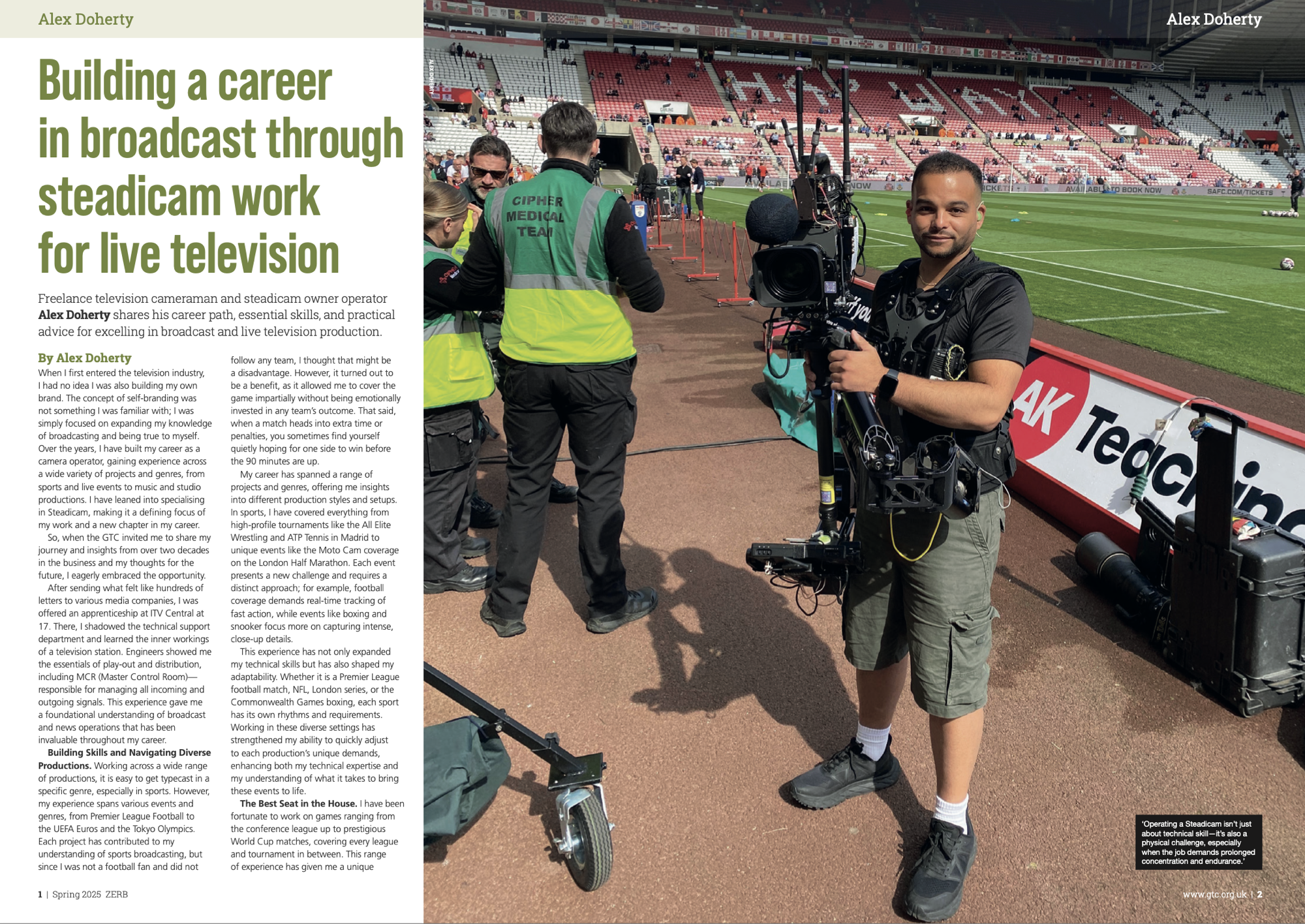
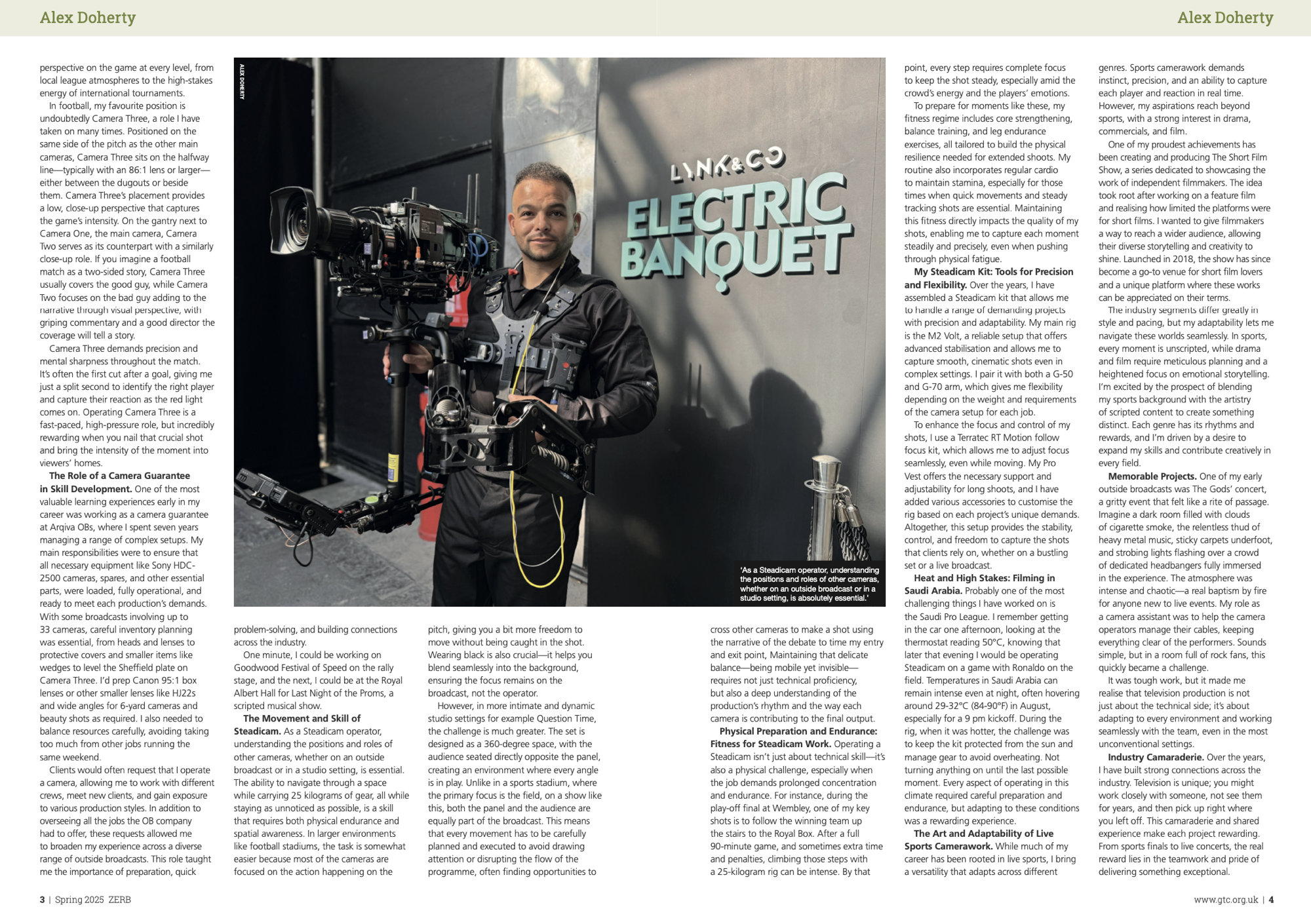
As a Steadicam operator, understanding the positions and roles of other cameras—whether on an outside broadcast or in a studio setting—is absolutely essential. The ability to navigate through a space while carrying 25 kilograms of gear, all while staying as unnoticed as possible, is a skill that requires both physical endurance and spatial awareness. In larger environments like football stadiums, the task is somewhat easier because most of the cameras are focused on the action on the pitch, giving you a bit more freedom to move without being caught in the shot. Wearing black is also crucial—it helps you blend seamlessly into the background, ensuring the focus remains on the broadcast, not the operator.
Operating a Steadicam isn’t just about technical skill—it’s also a physical challenge, especially when the job demands prolonged concentration and endurance.
In more intimate and dynamic studio settings—Question Time, for example—the challenge is much greater. The set is designed as a 360-degree space, with the audience seated directly opposite the panel, so every angle is in play. Every movement has to be carefully planned and executed to avoid drawing attention or disrupting the flow of the programme, often crossing other cameras to make a shot and using the narrative of the debate to time my entry and exit points. Maintaining that delicate balance—being mobile yet invisible—requires not just technical proficiency, but a deep understanding of the production’s rhythm.
Physical preparation and endurance
For instance, during the play-off final at Wembley, one of my key shots is to follow the winning team up the stairs to the Royal Box. After a full 90-minute game, and sometimes extra time and penalties, climbing those steps with a 25-kilogram rig can be intense. By that point, every step requires complete focus to keep the shot steady, especially amid the crowd’s energy and the players’ emotions.
To prepare for moments like these, my fitness regime includes core strengthening, balance training, and leg endurance exercises, all tailored to build the physical resilience needed for extended shoots, plus regular cardio to maintain stamina. Maintaining this fitness directly impacts the quality of my shots, enabling me to capture each moment steadily and precisely, even when pushing through physical fatigue.
My Steadicam kit: tools for precision and flexibility
Over the years, I’ve assembled a Steadicam kit that allows me to handle a range of demanding projects with precision and adaptability. My main rig is the Tiffen Steadicam M2 with Volt stabilisation, a reliable setup that lets me capture smooth, cinematic shots even in complex settings. I pair it with both a G-50 and a G-70 arm, which gives me flexibility depending on the weight and requirements of the camera setup for each job.
To enhance focus and control, I use a Teradek RT Motion follow-focus kit, which lets me adjust focus seamlessly, even while moving. My Pro Vest offers the necessary support and adjustability for long shoots, and I’ve added various accessories to customise the rig to each project’s unique demands. Altogether, this setup provides the stability, control, and freedom to capture the shots that clients rely on, whether on a bustling set or a live broadcast.
Heat and high stakes: filming in Saudi Arabia
Probably one of the most challenging things I’ve worked on is the Saudi Pro League. I remember getting in the car one afternoon, looking at the thermostat reading 50°C, knowing that later that evening I would be operating Steadicam on a game with Ronaldo on the field. Temperatures in Saudi Arabia can remain intense even at night. During the rig, the challenge was to keep the kit protected from the sun and manage the gear to avoid overheating—not turning anything on until the last possible moment. Every aspect of operating in this climate required careful preparation and endurance, but adapting to those conditions was a rewarding experience.
The art and adaptability of live sports camerawork
While much of my career has been rooted in live sports, I bring a versatility that adapts across different genres. Sports camerawork demands instinct, precision, and an ability to capture each play and reaction in real time. However, my aspirations reach beyond sports, with a strong interest in drama, commercials, and film.
One of my proudest achievements has been creating and producing The Short Film Show, a series dedicated to showcasing the work of independent filmmakers. The idea took root after working on a feature film and realising how limited the platforms were for short films. I wanted to give filmmakers a way to reach a wider audience, allowing their diverse storytelling and creativity to shine.
Memorable projects
One of my early outside broadcasts was ‘The Gods’ concert, a gritty event that felt like a rite of passage. Imagine a dark room filled with clouds of cigarette smoke, the relentless thud of heavy metal music, sticky carpets underfoot, and strobing lights flashing over a crowd of dedicated headbangers. My role as a camera assistant was to help the operators manage their cables, keeping everything clear of the performers—which sounds simple, but in a room full of rock fans quickly became a challenge. It taught me that television production isn’t just about the technical side; it’s about adapting to every environment and working seamlessly with the team, even in the most unconventional settings.
Camaraderie and networking: building connections that last
In this industry, connections are everything, and the camaraderie built with fellow crew members often opens doors to new opportunities. The television world is interconnected; the people you work with today could be the ones recommending you tomorrow. I’ve found that work begets work—if you’re actively engaged, dependable, and easy to work with, people take notice and remember.
Many of my most meaningful professional relationships began on set, often in intense and challenging conditions that fostered a strong bond. It’s common to work closely with someone on a project, not see them for months, and then pick up as if no time had passed. Over time, these relationships become part of your career foundation—you rely on your network not just for work but for advice, collaboration, and support in an industry that can be both unpredictable and highly competitive.
Personal growth and industry realities
Reflecting on my career, I’ve seen the television industry evolve in ways that make it both exciting and challenging. With larger companies downsizing and smaller ones emerging, budget cuts have often led to smaller crews and a greater emphasis on individual versatility. When working on a smaller crew, I’ve learned to be more self-reliant, troubleshooting technical challenges and adjusting in real time to maintain the quality viewers expect. I always bring my Steadicam kit as a full, reliable setup, knowing that my consistent rig and familiarity with my equipment will be essential in adapting to any production’s demands.
Delivering top-tier results isn’t just about having the latest gear or the largest team—it’s about honing technique, maintaining a focus on precision, and finding solutions in the moment.
Advice for newcomers
For those just starting, the television industry can seem daunting, especially with the influx of new talent. But there are ways to stand out. I often tell newcomers, ‘Don’t panic.’ In the beginning, it’s natural to worry about getting steady work, but in this field, your network truly is your net worth. Building connections can open doors, offer new opportunities, and provide support when you need it most. Most of all, be adaptable and don’t be too proud to turn down jobs that aren’t always as glamorous as you’d like. It’s not just about breaking in, but about creating a presence that endures.
A vision for the future in an AI-driven world
As technology evolves, I often find myself contemplating the future of camera operation, especially with AI and automation increasingly part of the conversation. There’s talk of robotics replacing some roles, but from experience, I believe there will always be a need for the human touch in sports broadcasting. When filming a live football match, so much hinges on split-second decisions—moments that are hard to rationalise but often just feel right. This intuition and spontaneity are irreplaceable.
That said, automation has proven useful in certain settings. Take the robotic head, like the Fletcher system, which I’ve used on the outside courts at Wimbledon. With LiDAR-tracked cameras, it allows me to oversee multiple cameras remotely, handling four angles at once without needing additional operators. It’s impressive and efficient—but even with these tools, nothing quite matches the dynamic instinct of an operator making real-time adjustments that enhance each shot’s storytelling impact.
Handling pressure with perspective
Television can be a high-pressure environment, but I’ve learned to put things in perspective. When things go wrong or tensions run high, it’s important to remember, as many say, ‘It’s only television, and no one’s died.’ That simple reminder helps me stay calm and focused. People may demand perfection, and we strive for it, but when circumstances spiral out of control, sometimes you just have to take a step back, laugh, and keep moving forward.
Looking ahead: embracing every opportunity
Reflecting on my journey so far, I’m reminded of the many lessons learned, the connections made, and the constant evolution that makes working in this industry so rewarding. Specialising in Steadicam has opened up a new creative path for me, and I’m eager to explore it further. Each project—whether covering live sports, capturing intimate studio moments, or working on dramatic productions—continues to push me to refine my skills and adapt to new challenges. I’m grateful for the opportunities and support I’ve received from mentors, peers, and clients along the way, and I look forward to wherever this journey takes me next.